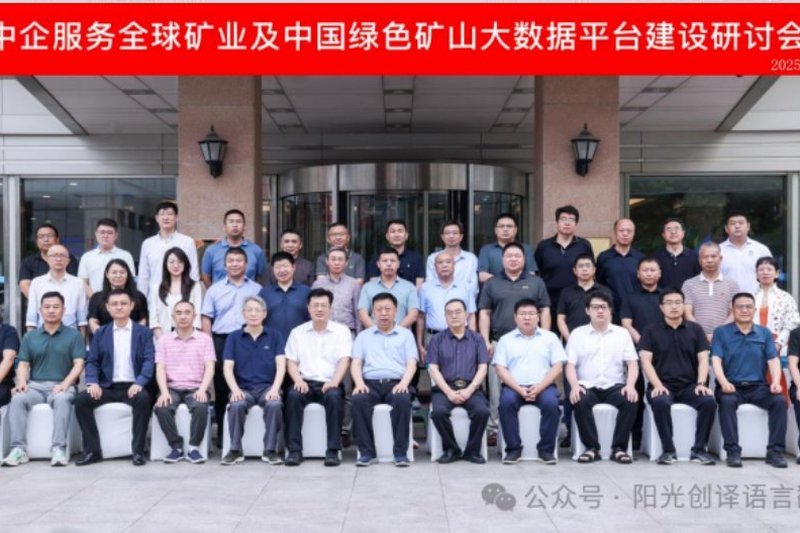
On 9 July 2025, Dr. Lyu Guo, Chairman of Beijing Suntrans, was invited to the "Seminar on Chinese Enterprises Serving Global Mining and Construction of China's Green Mine Big-Data Platform" hosted by the Zhongguancun Green Mine Industry Alliance (ZGMIA), held at Beijing Shengli Hotel. The seminar gathered Wang Min, former Vice Minister of the Ministry of Land and Resources, Ju Jianhua, former Director of the Department of Mineral Resources Protection and Supervision of the Ministry of Natural Resources, and ZGMIA Secretary-General Wang Liang, who all delivered keynote speeches.
Dr. Lyu emphasized that the core of both the global mining database and the China green-mine big-data platform lies in "cross-scenario adaptation". In global mining, "cross-cultural decoding" of data is foundational—behind different national definitions of "mining rights" and "resource quantity" lie differences in legal systems and cultural cognition. For example, African tribes view mineral resources as "gifts from ancestors"; using only industry jargon to communicate will block data collection. The 120,000-entry Global Mining Terminology Database built by Suntrans is precisely designed to solve this, making data not only "readable" but "understandable".
For technology to be implemented, one cannot blindly chase the most advanced. Faced with Indonesia's local data-storage requirements and the EU's GDPR, Dr. Lyu believes a "hybrid-cloud + local mirror" approach is pragmatic. AI also needs to combine human and machine intelligence: expressions like "average vein continuity" in Chilean reports are hard for machines to fully grasp, and require human calibration to convert into actionable information such as "mining costs may be 30% higher". Likewise, the green-mine big-data platform must adapt to different domestic mining areas' technical standards and ecological requirements—water-saving data from northwestern mines and ecological-restoration indicators from southern mines need differentiated presentation under a unified framework.
At the compliance and value-conversion level, Dr. Lyu proposed a "dual-track drive". The global mining database needs a "data passport" system marking source and circulation paths—retaining local data in the DRC, transmitting desensitized information to Europe and America—to balance multiple jurisdictions. The China green-mine platform needs a "dynamic link between national and local standards", mapping the Green Mine Evaluation Indicators with local ecological regulations, so that data meets national requirements while fitting the realities of each mining area. The profit model should not be limited to data sales, but provide "data + scenario services"—packages of "terminology translation + reserve data + community-relationship interpretation" for Chinese overseas M&A, and "monitoring data + policy matching + technical-transformation suggestions" for domestic mines.
Dr. Lyu concluded that the construction of China's green-mine big-data platform and the international mining database are part of the same thread: the former is the "deepening of local practice", the latter the "extension of global capabilities". Both must take "technology as the bone, scenarios as the flesh, and culture as the soul" to truly help Chinese enterprises deepen domestic green-mine construction and efficiently serve the global mining market.
← Back