From May 30 to June 1, 2025, Dr. Lü Guo, founder of Suntrans, joined an inspection delegation together with Chinese mining companies to carry out a three-day in-depth mining investigation in Mongolia. Centered on the core goal of “unlocking the potential of Central Asia’s resource hub”, the inspection delved into Mongolia’s abundant resources known as “a treasure trove of mining under the blue sky”. With the key platform of the Mongolian Mining Investment Ecosystem Association, it outlined a new path for China-Mongolia mining cooperation to shift from resource complementarity to industrial chain coordination. For several years prior to this trip, Suntrans has been supporting a series of Mining Investment Silk Road Forums hosted by the Embassy of Mongolia in China.
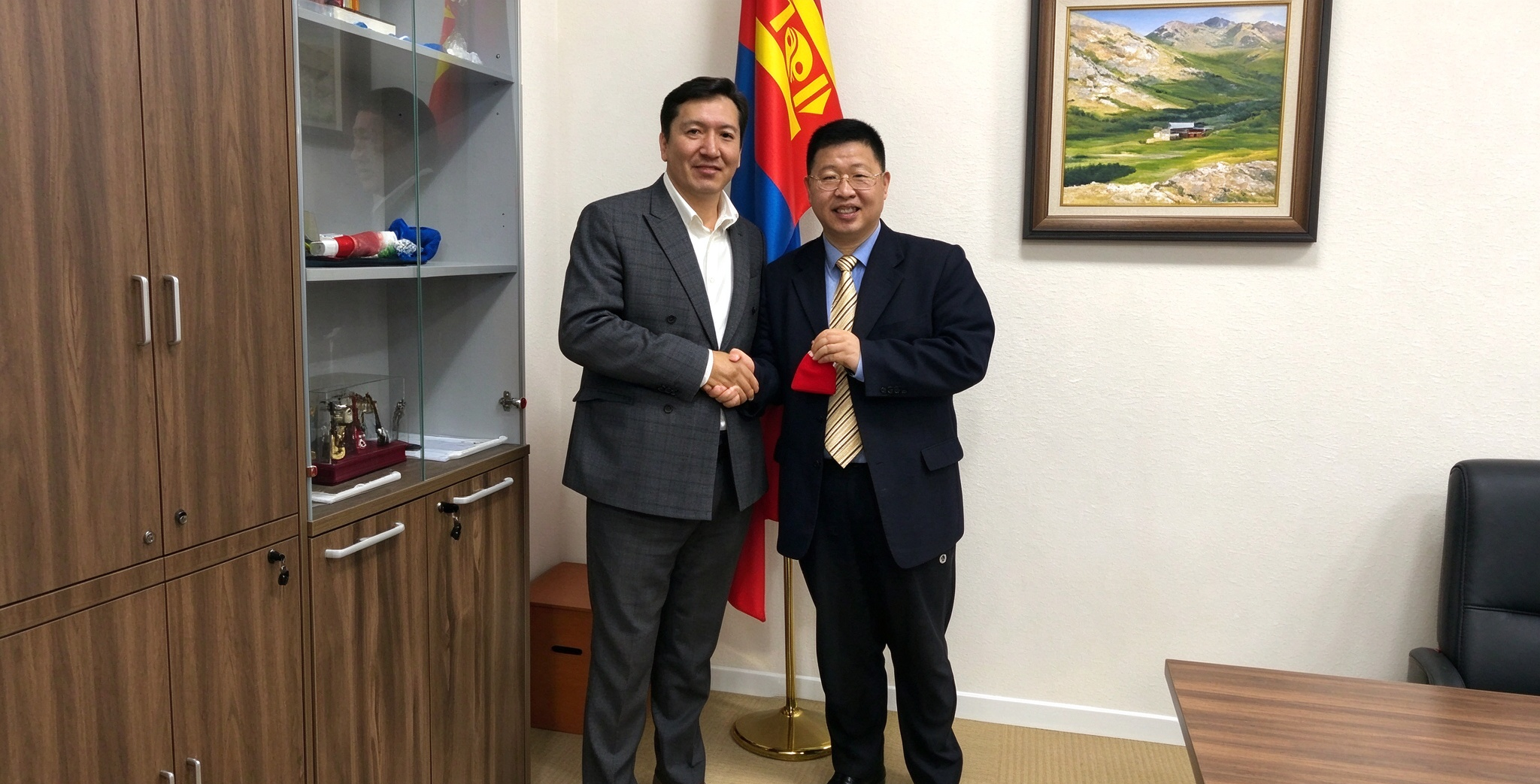
2025年5月31日蒙古国乌兰巴托蒙古矿业投资生态系统协会(Mining Investment Ecosystem Association of Mongolia)主席 Enkhtsog Lkhagvasuren先生向阳光创译董事长吕国博士赠送礼物I.
Mongolian Mining Investment Ecosystem Association: Core Hub and Practical Achievements for China-Mongolia Mining Cooperation Mongolian Mining Investment Ecosystem Association: Building a Golden Bridge for China-Mongolia Mining Cooperation
As Mongolia’s core mining organization integrating governmental, corporate and scientific research resources, the Mongolian Mining Investment Ecosystem Association has continuously advanced the in-depth development of China-Mongolia mineral resource cooperation in recent years. Aiming to build a full industrial chain service platform covering “exploration – mining – processing – trade”, the association focuses on three major functions: investment promotion, industrial coordination and green ecosystem development. It has become a vital link for China-Mongolia resource cooperation under the framework of the Belt and Road Initiative. Led by senior Mongolian mining experts and government officials, its management team provides one-stop services including policy consultation, project matchmaking and technical cooperation. In 2023, it successfully helped mining investment account for 72% of Mongolia’s foreign direct investment (FDI), attracted more than 50 Chinese-funded mineral projects and created over 12,000 jobs.
Full-industry-chain Business Layout Activates New Momentum for Mining Cooperation The association’s business covers four major segments: mineral resource development, investment services, industrial chain coordination and sustainable development. In the field of resource development, the 1.6-billion-USD uranium project promoted by the association has signed an agreement with Orano Group of France and is scheduled to be put into operation in 2028. Meanwhile, it supports China Nonferrous Metals Group in developing benchmark projects such as the Tumurtiin Ovoo Zinc Mine. In terms of investment services, the association provides Chinese-funded enterprises with full-cycle assistance ranging from mineral right approval to legal support, and introduces Chinese mine automation and green mining technologies to improve industrial efficiency. For industrial chain coordination, the association facilitates matchmaking between mining machinery suppliers and mining companies, collaborates with COSCO Shipping Group to optimize the China-Mongolia-Russia logistics corridor. It also carries out technical exchanges on ecological restoration together with China Mining Federation, helping enterprises including China Railway Resources Xinxin Company obtain international green certifications to strike a balance between resource exploitation and environmental protection.
Multi-field Linkages Paint a New Picture of China-Mongolia Cooperation The association’s cooperation with Chinese enterprises has extended to diverse sectors including energy, infrastructure, manufacturing and logistics. China National Petroleum Corporation participates in oil and gas development and cross-border pipeline construction in Mongolia; Zijin Mining deepens technical cooperation in non-ferrous metal exploration; WEGO Group explores localized production of medical equipment to support mining services. The SCO Demonstration Zone offers seaport access to the Chinese market for Mongolia’s mineral exports via its multimodal transport platform. In 2024, the association signed a Memorandum of Understanding with China Mining Federation to further advance arrangements in policy exchanges, green finance (exploring low-carbon project financing with the Astana International Financial Centre), and lithium resource development.
II. Understanding Mongolia’s Mining Policies and Development Opportunities
At the first stop of the investigation, Dr. Lü Guo learned about Mongolia’s mining policies and opportunities. Both sides held in-depth discussions on key topics such as China-Mongolia mineral resource development, energy collaboration and economic trade. During the exchange, they conducted a detailed analysis of Mongolia’s mineral resource endowment characteristics and future development plans, with special focus on the investment policy support system available for Chinese-funded enterprises. Ranging from specific procedures for mineral right approval and interpretation of preferential tax policies to clarification of environmental compliance requirements, the discussion sorted out a clear action roadmap for Chinese mining enterprises to “go global”, helping enterprises effectively break through various policy barriers.
III. Partnering with Leading Enterprises to Expand Cooperation Territory
(I) Exploring Industrial Chain Coordination with a Mongolian Group
As Mongolia’s largest state-owned energy and mining group directly under the state, the Mongolian mining group boasts solid strength and abundant experience in mineral resource development and on-site ore processing. Dr. Lü Guo held in-depth discussions with the group’s senior management on full-chain cooperation covering "resource exploration – mining – processing". Starting from the development potential of polymetallic deposits such as copper and gold, both sides discussed ways to carry out on-site processing and conversion at mining sites to raise product added value. They actively explored innovative cooperation models featuring complementary strengths between Chinese and Mongolian enterprises, laying a solid foundation for building a closer and more efficient mining cooperation ecosystem.
(II) Visiting a Chinese Mining Company to Gain Insights into Chinese-funded Mining Practices
At a Chinese mining group whose subsidiary polymetallic mining and beneficiation enterprise is an industry leader, Dr. Lü Guo gained an in-depth understanding of the production and operation status of Chinese-funded mining enterprises operating in Mongolia. A comprehensive investigation was conducted covering the practical application of mining technologies for gold, copper, lead-zinc polymetallic ores, implementation of localized operation strategies, and experience accumulated from community collaboration. On this basis, centered on the core theme of “cooperation in exploration and development of Mongolian mine resources” and leveraging Suntrans’ professional service capabilities in international mining consulting and technical translation, a full-process solution ranging from technical docking and policy adaptation to talent services was customized for Chinese-funded enterprises to "cultivate the Mongolian market".
IV. Linking Industry Associations to Build an Ecosystem Network
During the visit to the Mongolian Mining Investment Ecosystem Association, Dr. Lü Guo held forums and exchanges together with representatives from the association and major local copper-gold mining enterprises. As a comprehensive industry organization with extensive influence in Mongolia’s mining sector, the association brings together abundant resources across the whole industrial chain including exploration, development and finance. During the talks, both sides had thorough discussions on key topics such as “mechanisms for cooperative development of mineral resources”, “linkage of international mining capital” and “mutual recognition of technical standards”. They are committed to building an efficient platform for information sharing and project matching for Chinese and Mongolian mining enterprises, promoting the shift of bilateral cooperation from the previous “isolated operation by individual enterprises” to a new stage of “ecological coordinated development”
Roadshow on New Mining Policies: Insights into the Window of Opportunities In fact, Suntrans has already achieved remarkable results in promoting China-Mongolia mining cooperation. As early as April 26, Dr. Lü Guo from Beijing Suntrans Language Translation Co., Ltd., invited by the Embassy of Mongolia in China, provided full-range interpretation services for the mining project roadshow hosted by the Embassy. Covering multiple mineral types including lithium ore, iron ore, fluorite ore, copper ore, gold ore and lead-zinc ore, this roadshow helped Mongolian mining investors gain deeper understanding of new opportunities brought by the new mining policies introduced at the end of 2023. More than 100 participants attended the event, including relevant government officials from China and Mongolia, mining investors and practitioners along the industrial chain. Suntrans’ services have played a positive role in facilitating exchanges and cooperation between the two sides.
On August 16, 2024, at the 3rd "Silk Road Investment: Gold and Coal Project Showcase" hosted by the Embassy of Mongolia in China, Dr. Lü Guo was invited to provide interpretation and mining consulting services. This grand event showcased a rich portfolio of Mongolian mining projects involving gold, silver, copper and coal deposits. With his professional interpretation capability, Dr. Lü Guo helped international investors gain an in-depth understanding of the latest developments and investment potential of Mongolia’s mining projects, building a vital language bridge to deepen mining cooperation between China, Mongolia and the global mining community.
Overview of Mineral Resource Distribution in Mongolia Mongolia boasts widely distributed and diverse mineral resources, with more than 80 proven mineral types and over 6,000 mineral occurrences. Its core resources feature concentrated regional distribution. The Gobi Desert areas in southern and eastern Mongolia are rich in advantageous minerals such as coal, copper and gold. Examples include the Oyu Tolgoi Copper-Gold Mine in the South Gobi Province (holding 34 million tons of copper reserves and 1,300 tons of gold. As one of the world’s largest undeveloped deposits, it will export 90% of its copper concentrate to China after commissioning in 2025) and the Tavan Tolgoi Coal Mine (with reserves of 6.4 billion tons, one of the world’s largest coking coalfields). The flat terrain facilitates open-pit mining. The northern mountainous areas are dominated by iron, zinc and uranium resources. Iron ore in Darkhan-Uul Province and Dornod Province accounts for over 50% of the nation’s total reserves, while zinc ore in Khentii Province makes up 40%.
Besides core mineral resources, Mongolia is also rich in non-ferrous metals and rare metal minerals. A total of 421 occurrences of non-ferrous metal deposits including copper, lead and zinc have been discovered, among which 173 are copper deposits. There are 329 occurrences of rare earth minerals such as tungsten and tin. Mongolia holds 15 million tons of fluorite reserves, making it the world’s fourth-largest holder of this resource, and 75% of its fluorite is exported to China. Strategic resources including lithium (1 million tons LCE at the Chagan Nuur Lake deposit) and rare earths (3 million tons of oxides at the Mushige Khudag deposit) also show great potential. At present, its mining sector is underpinned by flagship mines such as the Oyu Tolgoi Copper-Gold Mine and the Erdenet Copper-Molybdenum Mine (with an annual capacity of 500,000 tons of copper concentrate). The China-Mongolia joint venture Chagan Subarga Copper Mine started construction in 2023. Nevertheless, its development faces challenges including underdeveloped infrastructure, shortages of technical professionals, environmental pressure and incomplete policies. As the backbone of the national economy, mineral exports account for over 70% of total foreign trade volume, continuously driving GDP growth and supplying foreign exchange for infrastructure construction and people’s livelihood. Endowed with rich resources and geographic advantages, Mongolia boasts huge potential in the global resource market. It needs international cooperation to break through development bottlenecks and achieve sustainable exploitation.
Leveraging Suntrans’ cross-border service capabilities as the fulcrum, Dr. Lü Guo’s investigation unlocks the development code of Mongolia — the “Central Asian resource hub” for Chinese enterprises, and brings Chinese technology and capital momentum to Mongolia’s mining industry. Going forward, Suntrans will continue to deepen its engagement in the international mining service ecosystem, push China-Mongolia cooperation forward from resource complementarity to industrial chain symbiosis, and write a new chapter of coordinated mining development under the Belt and Road Initiative.
← Back