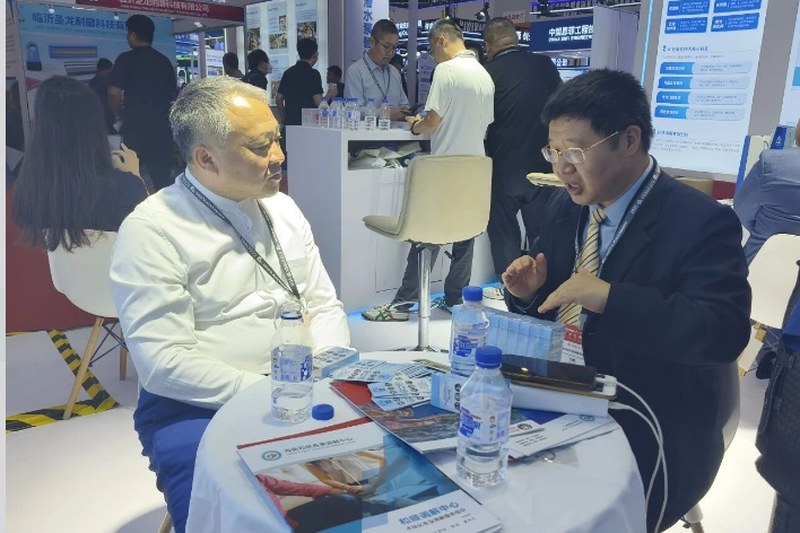
From 10 to 12 September 2026, the 28th China Mining Conference was held at Tianjin Meijiang Convention Center, drawing about 31,000 participants from 60 countries and international organizations. Dr. Lyu Guo of Suntrans met Mr. Cao Xusheng, senior partner of Beijing JingShi Law Firm, on-site for an in-depth dialogue on mining going global—one with over 20 years in mining translation, the other founder of China's first mining mediation committee—both standing at the very front of Chinese mining enterprises' outbound chain.
The dialogue first exposed the limits of AI translation. Dr. Lyu noted that core terms such as Mineral Resources, Indicated Resources and Inferred Resources, when fed directly to AI, are routinely mistranslated; for niche minerals with scarce online data, AI simply has no source to draw on. In legal settings, AI even fabricates non-existent precedents, false lawyer profiles and absurd fee schedules. Mr. Cao pointed out that fewer than 20 lawyers in China today truly qualify as mining lawyers—mining is a tightly coupled chain of exploration, mining, processing, smelting, evaluation, review and investment, and a single professional misjudgment can cost hundreds of millions of yuan.
The dialogue also confronted three categories of challenges in the accelerating outbound wave: roughly 20 African and 12 Asian countries have tightened raw-ore export policies and require local processing; in August 2026 Indonesia announced a mineral and strategic-commodity exchange to launch on 1 January 2027; the United States expanded its critical-minerals list from 50 to 60 items in November 2025. Meanwhile, in some overseas regions the security environment is complex and the personal and property safety risks facing Chinese mining practitioners are rising.
Both speakers jointly proposed three lines of defense. First, hand the critical links to seasoned human experts—final sign-off on geological reports, legal documents and cross-border negotiations must be human. Second, front-load disputes into mediation—embed mediation clauses in contracts, with arbitration and litigation as fallback. The Mining Mediation Committee of Hainan Heshun Commercial Mediation Center, of which Mr. Cao is director and Dr. Lyu a special mediator, is exactly that idea put into practice. Third, turn solo efforts into coalition action—central SOEs and private firms, chambers of commerce and overseas embassies working together, with the support of national power.
The dialogue returned to a larger view at the end: mineral resources are unevenly distributed worldwide, no country is self-sufficient, and globalization is inevitable. Dr. Lyu repeatedly stresses a community-of-shared-future mindset in his overseas interviews—every nation's mineral resources must be globally allocated, and mutual benefit is the only path to lasting stability. As Mr. Cao put it more plainly: when you think of the country, your own affairs fall into place. Profit is the foundation, the rule of law is the guarantee, and vision is the ceiling—the most practical reminder for every Chinese miner going global.
← Back