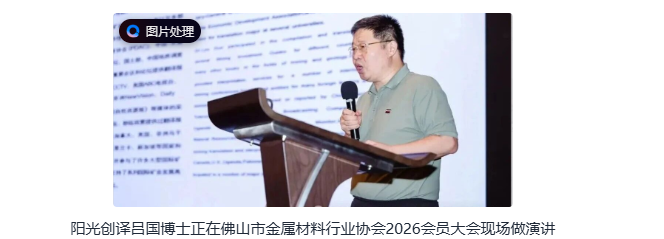
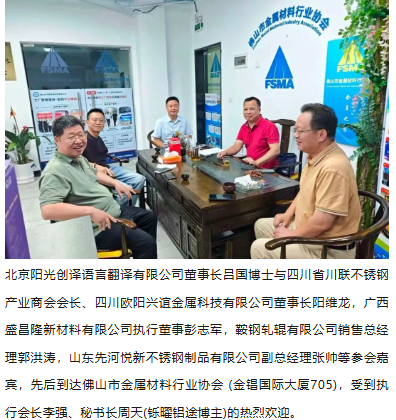
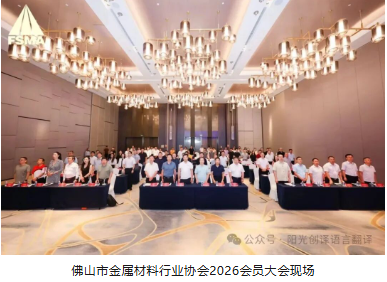
On August 18, 2026, the 2026 Member Conference of Foshan Metal Materials Industry Association was successfully held at InterContinental Foshan Dongping. Dr. Lü Guo, founder of Suntrans, was invited to attend the conference. During the special exchange session, drawing on years of frontline experience in global services for the metal industry, he delivered a systematic trend analysis and industry judgment on the current situation, annual changes and future prospects of Foshan’s stainless steel foreign trade.
Dr. Lü Guo believes that it is first necessary to clarify the core positioning of Foshan’s stainless steel industry: there are no large smelting steel mills in Foshan. The industry’s core strengths lie in deep processing and foreign trade of stainless steel. This directly shapes Foshan’s unique import and export structure. Its exports mainly consist of various deep-processed products, decorative sheets, pipes and hardware; imports are dominated by basic cold-rolled steel coils and small batches of high-end special stainless steel materials. Local enterprises hardly import mineral raw materials such as nickel and chromium directly. Benefiting from the geographical advantages of the two major core ports of Guangzhou and Shenzhen, Foshan has secured its position as the key hub for stainless steel foreign trade in South China. Industry statistics show that Guangdong Province’s total stainless steel exports consistently account for over 35% of China’s national volume, with Foshan serving as the primary contributor within the province and across the country.
I. Export Trends: Comprehensive Upgrading of Structure, Markets and Business Models
1. Continuous optimization of export product structure with widening gap between high-end and low-end segments
Based on this year’s market research by Dr. Lü Guo, the export product mix of Foshan stainless steel is undergoing structural transformation with a notable shift between old and new growth drivers.
First, traditional consumer goods remain the foundation of exports. Decorative stainless steel sheets, color-coated plates, welded pipes, kitchen & bathroom hardware and furniture hardware have long been Foshan’s major export categories, accounting for the bulk of local stainless steel export volume. However, drawbacks are becoming increasingly prominent. Ordinary low-grade 200-series sheets face mounting overseas anti-dumping pressure. The model of exporting bare low-priced sheets carries sharply rising risks and slim profit margins, with its market share continuing to decline. The old path of exporting low-end bare sheets is no longer viable.
Second, deep-processed finished products constitute the core growth track. An increasing number of Foshan enterprises have abandoned the extensive trading model of simply selling steel coils and raw sheets. Through a full set of deep processing procedures including slitting, leveling, color coating, stamping and welding, they export finished pipes, custom components, complete kitchen and bathroom products and other highly finished goods. The biggest advantage of this model is that it can effectively avoid anti-dumping tariffs on stainless steel sheets and greatly boost product added value. It has become the mainstream transformation route adopted by most leading foreign trade enterprises.
Third, high-end industrial products remain a noticeable weakness. Objectively speaking, Foshan’s export products are still heavily reliant on civil decorative goods. The export proportion of high-value special products such as industrial seamless pipes and duplex stainless steel for marine engineering, precision manufacturing and high-end equipment remains relatively low. There is still substantial room for Foshan’s stainless steel industry to upgrade toward high-end industrialization and precision manufacturing.
2. Restructuring of Export Market Pattern with Striking Polarization between Hot and Cold Markets
The RCEP Southeast Asian market remains the largest source of export growth. In Dr. Lü Guo’s view, Southeast Asia will serve as the most stable and promising core market for Foshan’s stainless steel foreign trade in the coming years. Countries including Vietnam, Thailand, Malaysia and Indonesia benefit from RCEP tariff preferences. Coupled with local infrastructure expansion and booming real estate construction, their demand for decorative sheets, pipes and hardware products stays robust. Leading Foshan enterprises have taken the lead in layout, setting up processing factories, overseas warehouses and exhibition & trade centers in Southeast Asia. They have built a dual-base operation model of “order acquisition & R&D in Foshan plus processing and assembly in Southeast Asia”. Leveraging rules of origin, they effectively circumvent trade barriers and greatly enhance market competitiveness.
Markets in the Middle East, Central Asia and Africa are expanding steadily. These emerging markets maintain overall stable growth. Local municipal renovation, high-end hotel decoration and public works generate strong demand. The proportion of custom engineering orders keeps rising, and local buyers highly recognize cost-effective stainless steel products from Foshan. They represent high-potential incremental markets worthy of in-depth cultivation for small and medium-sized foreign trade enterprises.
Market access thresholds for Europe, America and Japan keep rising. Trade barriers in developed markets are no longer limited to anti-dumping and countervailing duties. New requirements such as the CBAM carbon border adjustment mechanism, carbon footprint certification, product digital passports and environmental compliance certifications are continuously tightened. Ordinary steel sheets can hardly gain direct market access. At present, only high value-added deep-processed finished products with complete international certifications can enter the high-end markets of Europe, America, Japan and South Korea. The industry reality is clear: directly exporting ordinary steel sheets to European and American markets brings slim profit and extremely high trade risks. Most enterprises adopt re-export trade or process goods at overseas bases prior to export to avoid compliance and trade risks.
3. Four Core Shifts in the Industry’s Export Model
Dr. Lü Guo holds that with continuous updates of global trade rules and compliance systems, Foshan stainless steel foreign trade has completely departed from the traditional low-price, high-volume model, showing four major evolutionary trends:
Shift in product form: Exports are fully transforming from low-end bare sheet raw materials to high value-added deep-processed finished products, reducing anti-dumping trade risks at the source.
Shift in business model: From simply selling products to offering integrated engineering solutions of “materials + deep processing + technical services”, precisely matching project demands for overseas urban renewal, high-end hotels and municipal works.
Shift in production layout: From full domestic production for export toward cross-border layout of “R&D and order taking at domestic headquarters + coordinated production at Southeast Asian bases”, making good use of rules of origin to offset tariff pressure.
Shift in compliance system: Material traceability reports, complete carbon footprint data, third-party test certificates and mandatory certifications of importing countries have become mandatory prerequisites for overseas product sales. The living space for small and low-cost processing plants without compliance qualifications keeps shrinking.
4. Core Pressures Facing Current Industry Exports
Based on frontline market feedback collected this year, Foshan’s stainless steel foreign trade enterprises are confronted with four major operational pressures, which are also common pain points across the industry. First, global trade protectionism is on the rise. The United States, the EU, Japan, India and other countries frequently launch anti-dumping investigations, leading to a continuously tightening external trade environment. Second, Indonesia’s domestic stainless steel production capacity keeps expanding, greatly improving its self-sufficiency and directly squeezing China’s traditional market share in Southeast Asia. Third, nickel prices fluctuate sharply, causing drastic swings in raw material costs and bringing huge uncertainties to enterprises in order quotation, cost control and profit management. Fourth, the low-end market suffers from severe homogenization, and cut-throat low-price competition prevails, continuously squeezing the profit margins of small and medium-sized enterprises.
II. Import Trends: Shrinking Low-end Imports and Persistent Dependence on High-end Special Materials
Imports of basic steel coils keep declining. In earlier years, Foshan deep-processing enterprises relied heavily on imported cold-rolled stainless steel coils from Indonesia, South Korea and China’s Taiwan region. However, with the full release of large-scale smelting capacity in Fujian and Guangdong in China, domestic supply capacity for ordinary 200-series and 304-series basic steel coils has increased substantially with prominent cost-performance advantages, resulting in a continuous drop in imports of low-end basic steel coils.
Import focus shifts to high-end special materials. At present, China has overcapacity in ordinary stainless steel, yet there remains a capacity gap for high-end special materials. Duplex steel, high-purity precision steel strips and special corrosion-resistant alloys required for marine engineering, fine chemical industry and high-end medical equipment still need to be imported in small batches. As China’s core industrial cluster for stainless steel deep processing, Foshan undertakes customized processing demands for high-end products for a long time, so the import demand for such high-end coils will persist.
The characteristics of raw material supply are clear. Foshan’s industry is positioned for deep processing rather than smelting. Local enterprises hardly directly import mineral raw materials such as nickel ore and chromium ore. Core mineral raw materials including nickel and chromium are smelted and processed by large domestic steel mills. Foshan enterprises only purchase finished steel coils for secondary deep processing, featuring clear industrial division of labor and well-defined upstream and downstream coordination.
III. 2026 Overall Industry Outlook and Corporate Development Recommendations
Combining the market fluctuations throughout the year and the global trade landscape, Dr. Lü Guo presents a clear overall judgment on Foshan’s stainless steel foreign trade. The industry will long maintain a pattern dominated by exports and supplemented by imports. The direct export model of low-end bare sheets and ordinary steel plates has essentially hit a bottleneck. In-depth development of deep-processed finished products, delivery of integrated engineering solutions, and deployment of cross-border production capacity in Southeast Asia constitute the core path for enterprises to break free from cut-throat competition, avoid risks and capture incremental market opportunities. Entry barriers in high-end European and American markets will keep rising, and compliance and high-end positioning are essential prerequisites for market access. Meanwhile, emerging RCEP markets in Southeast Asia will act as the core growth engine of the industry in the coming years.
On the import side, the import volume of ordinary basic steel coils will continue to shrink, while stable import demand will remain only for high-end special stainless steel materials. For the vast majority of Foshan stainless steel foreign trade enterprises, escaping low-price homogenized competition, phasing out the low-end high-volume track, improving the product material traceability system, completing carbon footprint compliance documents and obtaining internationally authoritative certifications are the inevitable route to high-quality international development.
During Dr. Lü Guo’s years of providing global industry services, he has observed that many high-quality stainless steel products manufactured in Foshan frequently lose overseas orders due to non-standard foreign-related documents, unprofessional translation, incomplete compliance certifications and poor cross-border communication. With nearly two decades of experience serving the mining and metal industries, Suntrans specializes in providing full-spectrum services for metal and stainless steel enterprises, including foreign-related translation, compliance document polishing, overseas policy analysis and cross-border business support. It helps Foshan stainless steel enterprises expand overseas in a standardized, compliant and high-end manner and firmly seize incremental opportunities in the global market.
← Back