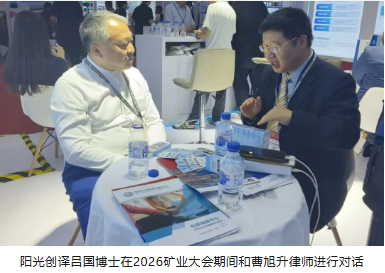
Dr. Lü Guo, Founder of Suntrans, met with Lawyer Cao Xusheng, Senior Partner of Jingshi Law Firm, at the 2026 (28th) China International Mining Conference held from September 10 to 12. They had an in-depth dialogue on mining overseas investment. The discussion centered on a core judgment: going global in the mining industry is not merely a race for mineral resources, but also relies on three lines of defense — professionalism, rule of law and safety.
At the conference venue, 31,000 participants from 60 countries and international organizations gathered at the Tianjin Meijiang Convention and Exhibition Center. The venue was packed with visitors, hotels were fully booked, large equipment was parked across the square, and both sides of the aisles were crowded with people taking group photos. This autumn, the booming momentum of the mining industry was clearly visible.
Amid the bustle, a discussion on risk unfolded in a corner of the exhibition hall. Dr. Lü Guo has traveled extensively on the frontlines of Africa and Central Asia with over 20 years of experience in mining translation. Lawyer Cao Xusheng has specialized in mining law for more than two decades and led the establishment of China’s first special committee for mining mediation. One focuses on translation, the other on legal affairs; they stand right at the front end of the value chain for Chinese mining enterprises going global. Covering the limitations of AI translation, resolution of overseas disputes, safety and compliance, the dialogue was packed with valuable insights. We have sorted out the most noteworthy takeaways for mining enterprises and practitioners as follows.
01 Do Not Blindly Trust AI: It Cannot Replace Mining Translation and Mining Legal Services
Let’s start with one key detail. Dr. Lü Guo has found that the fluency of AI translation is often misleading. Terms widely used in mining such as Mineral Resources, Indicated Resources and Inferred Resources are frequently mistranslated by AI — these errors are not occasional but common. Even for well-established professional expressions like Mineral Resources, Indicated Resources and Inferred Resources, AI makes mistakes despite massive online training data. For rare mineral varieties with limited publicly available data, AI simply lacks sufficient input to deliver reliable results.
Professional mining terminology translation in many cases still requires human judgment, said Dr. Lü Guo.
Legal scenarios pose even greater risks. In several mining-related legal projects he recently participated in, AI-generated texts added unsubstantiated content, including citations of non-existent cases and fabricated data. Worse still, when people search online for mining lawyers, AI may automatically generate fake profiles and fabricated, unreasonably low fee schedules. Such results are entirely unreliable, Dr. Lü Guo stressed frankly.
Lawyer Cao Xusheng put it more directly: to this day, there are no more than 20 lawyers in China who can truly be regarded as mining lawyers. Many claim to specialize in mining law yet cannot understand professional mining reports. If they fail to grasp fundamental mining knowledge, how can they be deemed professional mining lawyers?
Why are such professionals so scarce? Mining is a highly integrated industry encompassing exploration, mining, mineral processing, smelting, resource assessment, review, investment and financing, involving hundreds of sub-disciplines. Just like mining translators, mining lawyers build their competence through years of practice and countless real cases. For information unavailable online, AI can only fabricate content. A single error in professional judgment may result in the loss of hundreds of millions of yuan in investment.
The conclusion is clear: AI can serve as a tool, but never as the gatekeeper. The more critical the links, the more they must be handled by seasoned professionals with proven real-world case experience.
02 Accelerated Overseas Expansion Amid a Shifting Global Landscape
Why have these issues become so prominent now? Because Chinese mining enterprises are in a window of accelerated global expansion.
First comes the overseas investment boom. In recent years, Central Asia has become a hot spot for global mining investment. Thanks to geographic proximity, cultural similarities and linguistic connections, a large number of Chinese enterprises have entered the region. The dialogue mentioned that the number of newly registered Chinese-funded enterprises in Kazakhstan has risen from roughly 300 to over 1,800 in the past six years.
Nevertheless, the boom brings three concurrent challenges.
Policy adjustments in resource-host countries. Around 20 countries in Africa and 12 in Asia have tightened policies on raw ore exports, requiring local factory construction, higher local industrial added value and increased local equity ratios. Dr. Lü Guo conducted long-term research in Nigeria this year and interviewed leaders of local mining associations and SME associations. Local policies remain generally moderate, yet safety conditions for mining investment still require close attention, making some investors cautious.
Indonesia’s reform carries far-reaching implications. In August 2026, Indonesia announced the launch of a Minerals and Strategic Commodities Exchange starting January 1, 2027. Covering nickel, coal and other commodities accounting for more than 30% of global supply, all customs transactions must go through its information system. The goal is to capture authentic transaction data and strengthen the country’s pricing power over its mineral resources.
A more complex international environment. In November 2025, the United States expanded its critical minerals list from 50 to 60 varieties. Major global economies have raised the priority of critical minerals. Dr. Lü Guo mentioned cases where smoothly progressing overseas mineral projects of Chinese enterprises were forced to restructure due to external intervention. Such examples remind enterprises to prepare comprehensive contingency plans for overseas deployment.
Escalating safety and compliance requirements. Dr. Lü Guo admitted that security situations in some overseas regions are complicated, exposing Chinese mining practitioners to rising personal and property safety risks. Safety protection has become an unavoidable fixed cost for mining global expansion: armed security services, precious metal transportation protection and community engagement with local residents are compulsory lessons for overseas enterprises. The overseas operations of individual enterprises are deeply intertwined with the macro environment.
03 Three Lines of Defense: Professional Oversight, Mediation in Advance, and Collaborative Support
Risks are visible, and viable solutions were thoroughly discussed. The two speakers proposed three lines of defense for mining enterprises venturing overseas.
First, entrust critical procedures to human experts. AI may offer assistance for geological reports, legal documents and cross-border negotiations, but final verification must be performed by seasoned professionals with rich practical experience. Dr. Lü Guo noted that he and his team have worked for many years in Uganda, Zambia, Ethiopia, Nigeria and multiple Central Asian countries, gaining in-depth understanding of local mining policies and enterprise demands. Such accumulated insights cannot be delivered by any algorithm.
Second, adopt pre-litigation mediation for disputes. Lawyer Cao Xusheng calculated the trade-offs clearly: litigation is lengthy and costly. Instead of resorting to lawsuits once conflicts erupt, mediation clauses should be incorporated into contracts. When disputes arise, parties can turn to mediation platforms at the earliest stage. If mediation fails, arbitration and litigation serve as successive fallback options.
In July this year, the Mining Mediation Professional Committee of Hainan Heshun Commercial Mediation Center — China’s first specialized mining mediation committee — was officially established. Cao Xusheng serves as its director, and Dr. Lü Guo was appointed as a special mining mediator. Mining mediators are professionals who have deep passion for and decades of experience in the mining sector, understand mining practitioners and maintain extensive industry networks. They can turn negative disputes into positive outcomes: resolving conflicts, opening new ideas, matching resources and achieving win-win results for all parties.
Cao shared the outline of one case: a major Chinese gold group had a years-long dispute with a local partner on an overseas mining project, with substantial expenses solely on translation. If such disputes enter mediation in advance, third-party professionals familiar with mining, law and local rules can drastically cut costs and shorten timelines.
Furthermore, mediation platforms are evolving into an integrated hub for mining services. Behind every dispute, they can connect clients with professional expertise, financing resources, technical solutions and equipment suppliers. The platform brings together experts and institutions covering exploration, mining, mineral processing, smelting, assessment, review, investment, financing and mergers & acquisitions to form a super think tank. Translation, legal services, evaluation and finance are not omnipotent individually, but their integration enables full-industry-chain services. Hainan Heshun Commercial Mediation Center also plans to set up liaison offices in Hong Kong jointly with local law firms and arbitration institutions, and this model can be replicated in more countries in the future.
Third, shift from isolated competition to collaborative leveraging. Enterprises, central SOEs, private companies and local chambers of commerce should join forces. They shall promptly engage Chinese embassies and consulates overseas to leverage state support. Dr. Lü Guo stated that the capacity of a single enterprise is always limited. With backing from national authorities and overseas missions, the safety and rights protection for overseas operations gain a more solid foundation.
04 A Broader Vision Paves a Wider Path
Towards the end of the dialogue, the discussion rose to a bigger picture.
Both speakers agreed that mineral resources are unevenly distributed across the globe, and no country can achieve self-sufficiency. Globalization is an inevitable trend. China is the world’s largest producer, importer and trader of mineral products. A regulator for the external dependence of every single mineral commodity is necessary: without imports, prices may spiral out of control; excessive external dependence leaves a country vulnerable to external constraints. Global resource allocation and complementary advantages represent an unavoidable path.
History has shown the costs of isolation and confrontation. Some resource-host countries experienced drastic policy shifts, withdrawal of foreign capital and long-term mine shutdowns, severely harming local employment and economic development. These lessons deserve deep reflection. Dr. Lü Guo interviewed many officials and enterprise leaders in resource countries during overseas visits. He repeatedly conveyed a philosophy of a community with a shared future for mankind. This is no empty slogan; it is the fundamental logic of mining. No single nation’s mineral reserves can fully meet domestic demand, so global allocation is necessary. Only mutual benefit and win-win cooperation can deliver sustainable development.
He shared a personal experience: in negotiations for an overseas project, communication guided by this high-level philosophy helped resolve differences and secure the contract. When you think for the whole world, global partners will stand with you.
Cao expressed the same logic in plainer terms. At his law firm this year, he spends one third of his time handling cases, one third on public outreach for mining legal education, and one third on think tank work, submitting research findings and policy proposals to the state. When I prioritize national interests, my personal affairs become minor and are more likely to succeed.
For Chinese mining enterprises going global, these three sentences serve as the best annotation: profit is the foundation, the rule of law provides guarantees, and vision sets the ceiling. By consolidating the three lines of defense of professionalism, rule of law and safety and adopting a global perspective on resource allocation, mining enterprises will find the road for overseas expansion ever broader.
Throughout the dialogue, the two speakers avoided abstract theories and talked about tangible hurdles on the path of global mining investment. Professional judgment cannot be outsourced to AI; disputes should be resolved through mediation before escalation; safety and compliance are non-negotiable bottom lines. For mining global expansion, securing mineral deposits never equals success. Beyond resources, professionalism, rule of law and safety are the three lines of defense that truly determine how far an enterprise can go.
Returning to their meeting at the conference: Dr. Lü Guo focuses on translation, and Lawyer Cao Xusheng specializes in legal affairs. Together they brought to the surface two easily overlooked yet critical links along the overseas investment chain. Mining booms and busts will come and go, yet teams that uphold these three lines of defense can remain stable and forge ahead regardless of market cycles. This is perhaps the most practical reminder from this Tianjin Mining Conference dialogue for all mining professionals going global.
← Back